


I’ve Been Diagnosed With ADHD —
What Happens Now?
Healing Begins with Understanding
NOT Judgement

What Happen's now I have an ADHD Diagnosis?
Getting an ADHD diagnosis can answer questions you've carried for years. But sometimes it creates new ones too.
You might feel relieved.
You might feel angry that nobody noticed earlier.
You might start looking back at school, relationships, work and things you've struggled with and wonder:
“Was that ADHD too?”
Or perhaps, after spending so long wanting an answer, you're now thinking:
“Okay... but what am I supposed to do with this information?”
There isn't one right way to feel after an ADHD diagnosis — and you don't have to figure everything out straight away.
Does this feel familiar?
Since being diagnosed, perhaps you've found yourself thinking:
“I knew there was something.”
“Why did nobody notice?”
“Do I have to tell people?”
“Maybe I wasn't lazy after all.”
“How much of my life would have been different if I'd known?”
“What am I actually supposed to do now?”
“Is this ADHD or is this just me?”
“What if they've got the diagnosis wrong?”
Or you might feel:


Those feelings don't cancel each other out.

Why can an ADHD diagnosis bring up so much?

Is everything about me or ADHD now?
An ADHD diagnosis doesn't just give you information about how your brain works. It can change the way you understand your story.
Things you previously explained as:
I'm lazy.
I'm disorganised.
I'm too sensitive.
I never reach my potential.
I should be able to manage this.
May begin to look different.
That can feel freeing. At the same time, understanding yourself more compassionately now can also highlight how little compassion you may have received before.
You don't have to brush past that with:
“At least I know now.”
You can be glad you know and have feelings about how long it took to find out.
After diagnosis, it can be tempting to examine absolutely everything:
Is that ADHD?
Is that masking?
Is that executive funtioning?
Is that just my personality?
You don't have to separate yourself into:
ADHD ME and REAL ME.
Your personality, brain, relationships, history, values, humour, interests, difficulties and experiences have developed together.
A gentler question maybe:
Knowing what I know about myself now, what helps me live more comfortably as me?
What happens next?

There isn't a universal post-diagnosis pathway.
Depending on how and where you were assessed, you might explore things such as medical follow-up, medication discussions with an appropriate clinician, psychoeducation, peer support, practical ADHD support, workplace adjustments, Access to Work where eligible, or counselling and psychotherapy. Provision varies across the UK.
But you don't have to do everything.
And you certainly don't have to become an expert on ADHD this week.
It can take time to:
learn → notice → experiment → discover what actually works for you.
Something being recommended for ADHD doesn't automatically mean it will be right for your ADHD.
Imagine if...

Instead of asking:
“Why can't I just do this?” you gradually became more able to ask:
“What makes this difficult for me?”
Instead of:
“I should be able to cope.” perhaps:
“What would make this easier?”
Instead of forcing yourself through something until you're completely exhausted:
“What am I noticing about my capacity?”
And instead of:
“Why am I like this?” perhaps:
“What am I beginning to understand about myself?”
That doesn't mean every difficulty disappears.
It means you may gradually have different information with which to respond to yourself.
How Counselling Can Help
Counselling isn't about making you less ADHD.
It isn't about teaching you how to manage yourself well enough to fit everybody else's expectations.
It can give you somewhere to explore what this new understanding means specifically for you.
That might include:
grief about the past
anger that nobody noticed
shame
masking
relationships
confidence
feeling different
understanding your needs
boundaries
overwhelm and capacity
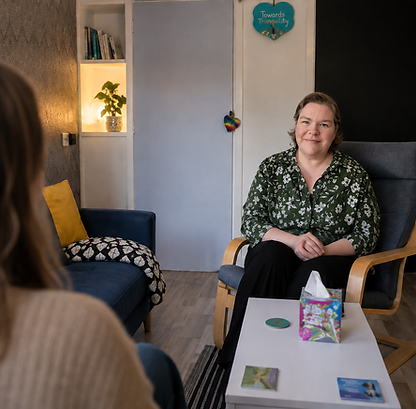
Or simply somewhere to say:
“This finally makes sense — and I don't quite know how I feel about that.”
Over time, the aim may be less about:
“How do I manage my ADHD properly?”
and more about:
“I'm understanding myself better and learning how to build a life that works better for me.”
That distinction is one of the strongest themes in your original blog and I would absolutely carry it into the Experience Library.
Click the button below to book a time that suits you.
A gentle next step
You don't have to completely reinvent your life because you've been diagnosed with ADHD.
Perhaps for now, simply notice:
Something that makes more sense now
What have I been blaming myself for that I might understand differently?
Something I'm curious about
What would I like to understand more about how my brain works?
Something that might help
Is there one everyday difficulty where I could experiment with doing things differently rather than trying harder?
You don't need all the answers.
Understanding yourself can happen gradually.