
How Do I Know If a Therapist Is Right for Me?

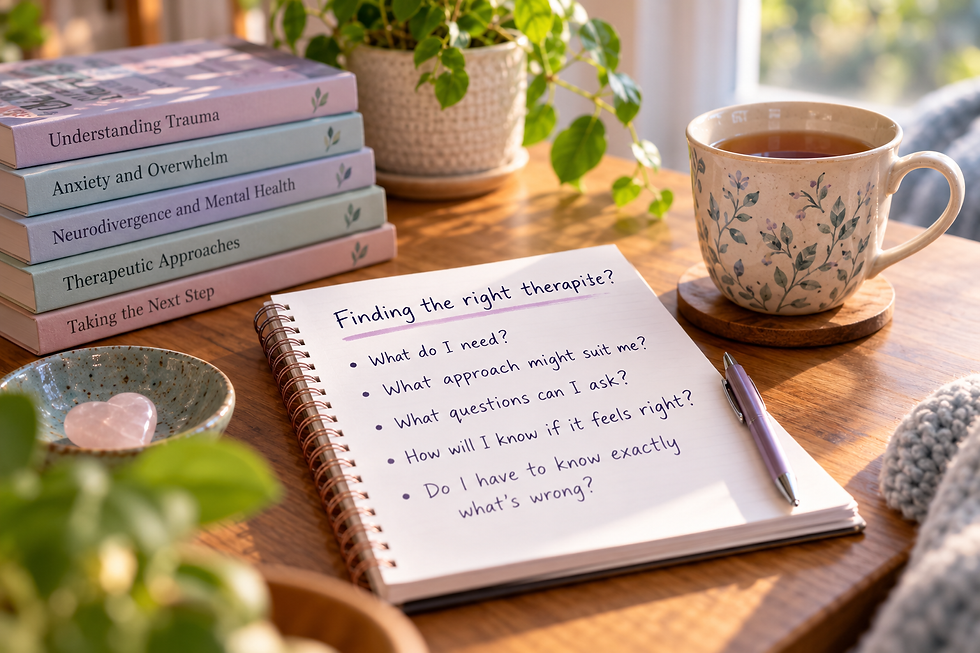
What to look for, what to ask, and why you're allowed to have preferences.
You've decided that you might like to try counselling. Perhaps you've been thinking about it for months. Maybe something has happened recently that's made you feel you could do with some support. Or perhaps you're not entirely sure why things feel so difficult, but you know you don't want to keep managing everything on your own.
So you start looking for a therapist and suddenly there are hundreds of them. Person-centred, Integrative, Psychodynamic, CBT, Trauma-informed, Neurodivergent-affirming, Online counselling, Face-to-face counselling etc etc.
Everyone seems to have different qualifications, approaches, specialisms and ways of describing what they offer.
You might find yourself wondering:
How Do I Know If a Therapist Is Right for Me? When I don't even know what I need!
It's a really understandable question and perhaps the first thing worth knowing is that you don't have to understand everything about therapy to begin looking for someone who might be able to help.
Do I need to know what's wrong before I contact a therapist?
No.
Some people come to counselling with a very clear idea of what they want support with. They might be experiencing anxiety, struggling with a relationship, processing something traumatic or trying to understand patterns that keep appearing in their lives. Other people find it much harder to explain. Perhaps you're feeling overwhelmed, exhausted, disconnected or simply not quite yourself. Maybe you've spent years coping, pushing through and getting on with things, and you're not even sure where you'd begin if someone asked how you were feeling.
You might worry that you'll contact a therapist and they'll ask what you'd like to work on, and your mind will go completely blank. That doesn't mean you're not ready for counselling. Sometimes understanding what's happening, finding the words to describe it and recognising what you need are all things you can begin exploring within therapy itself.
You don't have to arrive with a neatly organised explanation of your difficulties.
Does the type of therapy matter?
When you start looking for a therapist, you might come across all sorts of unfamiliar words. Person-centred. Psychodynamic. Integrative. CBT. ACT and then there are terms like therapeutic approach, modality and intervention.
You might find yourself thinking:
"I don't even know what half of these words mean. How am I supposed to know which one I need?"
It's a fair question. Sometimes the language used within counselling can make something that's already quite daunting feel even more complicated. These are words that therapists become familiar with through their training, but that doesn't mean everyone else should be expected to understand them. You certainly shouldn't have to learn a whole new vocabulary before you can ask for help.
When therapists talk about their approach, they're generally describing how they understand people's difficulties and how they work with clients.
Different approaches place emphasis on different things.
For example:
Person-centred therapy focuses on understanding your experiences from your perspective, with an emphasis on empathy, acceptance and the relationship you develop with your therapist.
Cognitive Behavioural Therapy (CBT) looks at how thoughts, feelings and behaviours can influence one another. It often includes practical ways of understanding and responding to difficulties.
Psychodynamic therapy explores how past experiences, relationships and patterns we might not always be aware of can influence how we feel and respond today.
Acceptance and Commitment Therapy (ACT) explores how we can make room for difficult thoughts and feelings without allowing them to determine everything we do, while finding ways to move towards what matters to us.
Integrative therapy means the therapist has trained in and draws upon different approaches rather than working exclusively in one way.
These are brief explanations, and there's much more to each approach than I've described here. You might read them and immediately feel drawn towards one.
Or you might still be thinking:
"That sounds interesting, but I haven't got a clue which would actually help me." and honestly that's okay. You don't necessarily need to work that out on your own.
You could ask a therapist:
"I've seen that you work in a particular way, but I'm not really sure what that means. Could you explain what a session with you might actually look like?"
Or perhaps:
"I'm not sure whether I need practical strategies or somewhere to talk things through. Is that something we could explore together?"
A therapist should be able to explain how they work without expecting you to understand professional terminology and if you don't understand their explanation, you're allowed to ask them to explain it differently.
You don't need to become knowledgeable about counselling to be able to benefit from it.
It's the therapist's responsibility to help you understand what they're offering so that you can make an informed choice about whether it might suit you.
What if I need something different from what other people seem to need?
This is something I think is particularly important. We all bring different experiences, needs, preferences and ways of communicating into therapy.
Some people find it helpful to have plenty of quiet space to think. Others find long silences uncomfortable and prefer a therapist who is more conversational. Some people want practical strategies alongside emotional exploration. Others need time to understand what's happening before they can begin thinking about changes.
You might prefer a therapist who is curious or gently challenges you, or you might need someone who initially focuses on helping you feel safe enough to explore difficult experiences.
Perhaps you process information more easily when it's written down. Maybe you find direct questions helpful, need additional time to respond, prefer not to maintain eye contact or sometimes struggle to identify what you're feeling.
These aren't things you necessarily need to overcome to make therapy work. They're things worth being able to talk about.
For people who are autistic, ADHD, have sensory differences, trauma histories or communication needs, flexibility can be particularly important.
This isn't only relevant to neurodivergent people. Everyone has preferences and being able to express those preferences can help create a therapeutic relationship that works better for you.
Should I choose someone who specialises in what I'm experiencing?
Sometimes, yes.
If you're looking for support with a particular difficulty, it can be helpful to find someone with relevant training and experience.
For example, if you're experiencing complex trauma, significant dissociation, eating difficulties or ongoing suicidal thoughts, you may want to ask about the therapist's experience and confidence in supporting people with similar difficulties. But there's something else worth knowing.
Two therapists might both have experience supporting people with trauma, anxiety or distressing memories, yet work in quite different ways.
And those differences might matter to you.
Does working through trauma mean I have to talk about everything that happened?
Not necessarily.
One of the things people sometimes worry about when considering trauma therapy is whether they'll be expected to describe painful experiences in detail, relive what happened or talk about things they're not ready to share.
There are different ways of working with trauma, and not all of them require you to give a detailed account of your experiences.
For example, at Towards Tranquility Therapy, Rachel and I both support people who have experienced trauma, but we can draw on different approaches.
Liz — The Flash Technique
I use the Flash Technique, an approach designed to help reduce the distress associated with upsetting memories without requiring you to describe or focus directly on the most painful parts of what happened.
Rather than spending a long time concentrating on the difficult memory, we use a carefully guided process that allows you to keep your attention mainly on something more pleasant or engaging.
For some people, particularly those who find the idea of revisiting traumatic experiences overwhelming, this can offer a gentler-feeling way of beginning to work with distressing memories.
Rachel — The Rewind Technique
Rachel uses the Rewind Technique, which involves a guided process where you imagine viewing a difficult experience from a distance, rather than going through it as though it's happening again.
The aim is to help reduce the emotional intensity associated with a distressing memory, while allowing you to maintain some distance from the experience.
Like the Flash Technique, it doesn't usually require you to describe everything that happened in detail.
How are these different from EMDR or other trauma therapies?
You may have heard of EMDR (Eye Movement Desensitisation and Reprocessing), another approach used to help people process traumatic memories.
EMDR often involves briefly bringing aspects of a distressing memory to mind while following guided eye movements or other forms of alternating stimulation, within a structured therapeutic process.
The Flash Technique was originally developed within the EMDR field, although it uses a different way of approaching distressing memories.
The Rewind Technique also works differently, using guided imagery and psychological distance rather than the standard EMDR process.
One of the potential attractions of Flash and Rewind is that they can involve less direct engagement with the most upsetting details of a memory. But that doesn't automatically make them better, safer or more suitable for everyone.
EMDR has a stronger research base for treating PTSD than either Flash or Rewind. Research into Flash is developing, while the evidence for Rewind remains more limited.
Different approaches have different strengths, limitations and levels of research supporting them.
The important question isn't simply which technique sounds best. It's whether the approach is appropriate for your experiences, needs and circumstances.
For some people, focused work with particular distressing memories may be helpful.
For others, especially where trauma has been repeated, happened within relationships or continues to affect many areas of life, therapy may also need to explore safety, trust, emotional regulation, relationships and how those experiences have shaped their understanding of themselves.
Sometimes the most useful starting point isn't processing a memory at all. It might be developing a sense of safety, understanding what's happening in your body, exploring your needs or building enough trust to begin talking about difficult experiences. That's important too.
What can I ask a therapist about their experience?
You might find it helpful to ask:
"Have you worked with people experiencing something similar to me?"
"How do you approach this kind of difficulty?"
"Would I need to talk about what happened in detail?"
"What happens if I become overwhelmed or need to stop?"
"How do we decide whether a particular technique is suitable for me?"
"What additional training or experience do you have in this area?"
A therapist doesn't need to have personally experienced everything you've been through to understand and support you. But they do need to recognise the limits of their knowledge and competence, work ethically and be willing to discuss whether they can offer the support you need.
It's also reasonable to check their qualifications, professional registration or membership, and whether they work within an established ethical framework.
In the UK, the titles counsellor and psychotherapist are not generally protected by law, so checking someone's training and professional standing can be particularly useful.
And remember, you're allowed to ask how someone works before deciding whether you want to work with them.
You don't have to agree to a particular technique simply because a therapist offers it.
Good therapy should involve understanding your options, discussing what feels manageable and making decisions together.
What if I don't feel comfortable with the therapist?
This is where things can become a little more complicated. Starting therapy can feel uncomfortable, even when you've found someone who might be a good fit. You may be nervous about sharing personal experiences, worried about being judged or unsure what to expect and if you've spent much of your life feeling misunderstood, criticised or dismissed, it may take time to trust someone new.
So feeling nervous doesn't automatically mean you've chosen the wrong therapist, but neither does it mean you should ignore everything you're noticing.
It might help to consider the difference between:
Feeling uncomfortable because you're exploring something difficult
and
Feeling uncomfortable because of how you're being treated.
For example, you might feel vulnerable after talking about something painful, while also recognising that your therapist listened carefully, respected your boundaries and responded compassionately.
That's different from repeatedly feeling dismissed, pressured, shamed or unable to express disagreement. You don't have to feel completely relaxed with someone straight away. But it matters whether there seems to be room for your feelings, questions and concerns.
Am I allowed to disagree with my therapist?
Absolutely.
Therapy isn't supposed to be a situation where one person always knows what's best and the other is expected to agree. A therapist may offer observations, ask questions or invite you to consider something from a different perspective. Sometimes that can feel challenging. But there's a difference between being challenged in a way that helps you think and being challenged in a way that leaves you feeling ashamed or diminished.
You might say:
"I'm not sure that fits for me."
"I don't think that's quite what I meant."
"Could we approach this differently?"
"I found something about our last session difficult."
How your therapist responds to these conversations can tell you something important about the relationship. A therapist won't always get everything right and that's something I own right from the start of working with someone, because I'm a human being and I want you to know you can be too.
The therapist may misunderstand something or make an assumption that doesn't fit your experience, we do try hard not to though. What's important is whether there's space to recognise that, talk about it and work towards understanding.
You shouldn't have to become a different version of yourself to be a good therapy client.
What practical things should I think about?
Sometimes we focus so much on finding someone who seems like a good therapist that we overlook whether attending therapy will actually be manageable and those practicalities matter.
For example:
Can you afford the fee regularly without creating additional financial pressure?
Are appointments available at times that work for you?
Would you prefer online or face-to-face sessions?
Is the location accessible?
Would a shorter or longer session suit your needs?
Are there sensory or communication adjustments that would help?
What happens if you need to cancel or rearrange an appointment?
How does the therapist manage confidentiality and personal information?
It's also worth thinking about whether you want short-term support around a particular issue or something more open-ended.
You don't have to know exactly how long you'll need therapy, but discussing expectations and practical arrangements can help you decide whether working together is realistic and sustainable.
What questions can I ask before booking?
You don't need to interview a therapist or arrive with a long list of questions. But you are allowed to ask about anything that matters to you.
You might want to know:
"How would you describe your approach to therapy?"
"Do you have experience supporting people with difficulties similar to mine?"
"What happens if I struggle to talk or don't know what to say?"
"Can we adapt sessions around my communication or sensory needs?"
"What if I feel that something isn't working?"
"How do you handle confidentiality?"
"What are your fees, cancellation arrangements and availability?"
You can also ask whether they offer an initial conversation before committing to sessions. Some therapists offer a brief free consultation, while others charge for an initial assessment or first appointment.
Neither arrangement automatically tells you whether someone is a good therapist.
What's more useful is understanding what the initial contact involves and whether it gives you the information you need.
What if I've tried therapy before and it didn't help?
You might be reading this having already had counselling that didn't feel particularly helpful. Perhaps you didn't feel understood. Maybe the therapist's approach didn't suit you, the timing wasn't right, or there were things you weren't ready or able to explore. You may even have had an experience that left you feeling worse.
It's understandable if that makes the idea of trying again difficult. But an experience with one therapist doesn't necessarily tell you what every therapeutic relationship will be like. There may be something useful in reflecting on what didn't work.
Not because you need to work out what you did wrong, but because it might help you recognise what you'd prefer or need to be different.
For example:
Did I need more time?
Was the approach too structured, or not structured enough?
Did I feel able to say when something wasn't helping?
Were my experiences understood?
Did I feel pressured to work on something before I was ready?
Sometimes, even after reflecting, you might not know why it didn't work.
That's okay too.

I've found someone who seems suitable. What now?
You might decide to send an email, make a telephone enquiry or arrange an introductory conversation. You don't need to explain your entire life story in that first message.
Something as simple as:
"Hello, I'm looking for some counselling support and wondered whether you're currently taking new clients. I'd be interested in finding out a little more about how you work and your availability."
is enough to begin. If there are particular needs or questions you want to raise, you can include those too.
If you have an initial session, remember that you're allowed to take some time afterwards to reflect. You don't necessarily need to make an immediate decision.
You might ask yourself:
Did I feel listened to?
Could I imagine gradually becoming more comfortable with this person?
Did they seem interested in understanding my experiences rather than making assumptions?
Did I feel able to ask questions?
Are there things I'm uncertain about that I'd like to discuss?
Sometimes you'll have a fairly clear sense that you'd like to continue. Sometimes you won't. You can take your time where circumstances allow.
A free worksheet to help you choose a therapist

I've created a free reflective worksheet called Finding the Right Therapist for You to accompany this blog.
It isn't a test, and there's no score at the end telling you which therapist to choose.
Instead, it gives you space to think about:
What you're hoping therapy might help with
Different therapeutic approaches
Qualities that matter to you in a therapist
Practical needs and accessibility
Questions you might want to ask
What you notice when speaking to or meeting someone
Your possible next steps
You don't have to complete every section. You might find one question particularly helpful, or you might prefer to come back to the worksheet as you explore your options.
A final thought
Finding a therapist isn't about discovering the one perfect person who will always understand you immediately or know exactly what to say.
Therapists are human, and therapeutic relationships develop over time. But you deserve to work with someone who treats you with respect, takes your experiences seriously and is willing to understand what you need.
Someone whose qualifications and experience are appropriate for the support you're seeking. Someone you can ask questions of, express uncertainty with and hopefully begin to develop trust in and if you're not entirely sure what you need yet, that's something you can explore too.
You don't have to have everything worked out before you ask for support.
At Towards Tranquility Therapy, Rachel and I offer counselling with an emphasis on compassion, curiosity and understanding each person's individual experiences and needs.
If you'd like to find out more about how we work, you're welcome to explore our website or get in touch and whether you choose to work with us or someone else, I hope you find support that feels right for you.


Comments